
As more institutions and governments begin discussing Bitcoin, one question keeps coming up:
Could Bitcoin eventually become a global reserve asset?
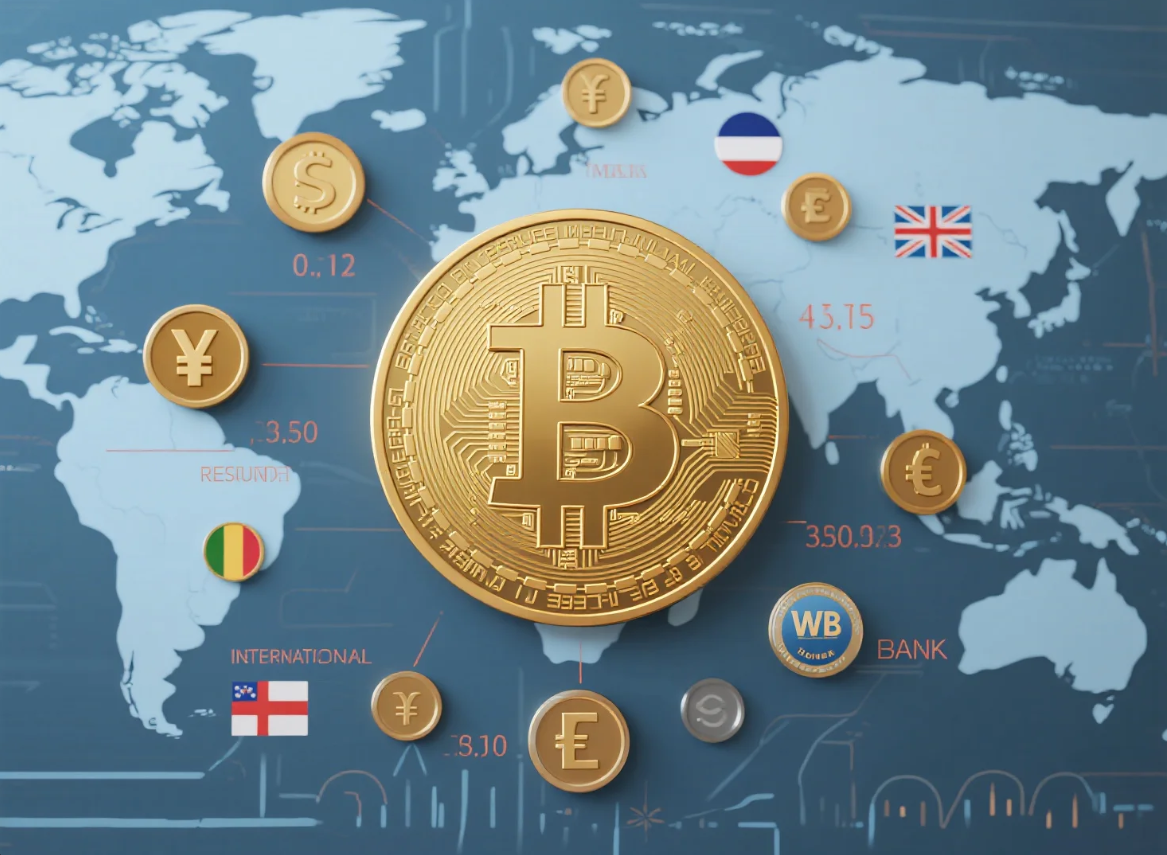
Today, the world’s primary reserve assets include:
Whether Bitcoin could join this group is not just a financial question. It also touches on broader issues such as:
To understand the debate, we need to look at several key factors.
A reserve asset is an asset held by governments or central banks to maintain financial stability.
These assets are typically used to:
Currently, the two most important global reserve assets are the U.S. dollar and gold.
The U.S. dollar remains the dominant global reserve currency.
Approximately 60% of global foreign exchange reserves are still denominated in dollars.
This gives the dollar a powerful role in the international financial system, influencing trade, finance, and global liquidity.
Gold is another major reserve asset.
Many central banks still hold large amounts of gold because it offers:
For these reasons, gold has long been viewed as the ultimate safe-haven asset.
Supporters argue that Bitcoin shares several characteristics with gold.
Bitcoin’s supply is permanently capped at 21 million coins.
This fixed supply gives Bitcoin several monetary characteristics:
In a world where governments can expand money supply, this feature is particularly attractive to some investors.
Bitcoin operates on a global network and offers strong liquidity advantages.
It can be:
This makes Bitcoin especially appealing in certain geopolitical environments.
The Bitcoin network does not depend on any single government or central authority.
For some countries and institutions, this creates the possibility of a financially neutral asset that exists outside traditional political structures.
Some governments and institutions have already begun experimenting with Bitcoin.
For example:
At the same time, several publicly traded companies have begun accumulating Bitcoin.
The most well-known example is:
This trend is often referred to as a corporate Bitcoin treasury strategy.
Despite its potential, Bitcoin still faces major challenges before it could become a global reserve asset.
Reserve assets generally need to maintain relative price stability.
Bitcoin, however, remains highly volatile.
It is not uncommon for Bitcoin to experience 50% price swings within a year, which presents a significant risk for central banks.
Bitcoin’s market capitalization is still relatively small compared to traditional reserve assets.
For context:
Bitcoin is still in a growth phase and has not yet reached comparable scale.
Global reserve currencies are closely tied to national power.
The dominance of the U.S. dollar is supported by:
Bitcoin, in contrast, does not have a nation-state backing it, which places it in a unique position within the global financial system.
Many analysts believe Bitcoin is more likely to become a complementary reserve asset, rather than replacing the U.S. dollar.
Possible scenarios include:
In this role, Bitcoin could function similarly to how central banks currently hold gold.
If several major developments occur simultaneously, Bitcoin’s role in the global financial system could expand significantly.
For example:
Under such conditions, Bitcoin could gradually evolve into a global macro asset, similar to:
If Bitcoin increasingly becomes viewed as a reserve asset, several changes could occur in the market:
However, this could also mean fewer short-term speculative opportunities as the market matures.
In the short term, Bitcoin is unlikely to replace the U.S. dollar as the world's primary reserve asset.
But over the long term, Bitcoin could gradually become:
one of the important reserve assets of the digital era.
Many people already refer to this potential role as:
digital gold.
In the near term, this is extremely unlikely.
The U.S. dollar is supported by a complete financial system, global trade networks, and strong geopolitical influence.
Bitcoin is more likely to act as a complementary reserve asset, not a replacement.
Countries with the following characteristics may be more open to experimenting with BTC:
Gold has long served as a reserve asset because it offers:
For Bitcoin to become a reserve asset, it would need to gradually build similar trust.
Bitcoin ETFs make it easier for institutions to invest in Bitcoin.
As institutional capital enters the market, Bitcoin may increasingly be viewed as a mainstream financial asset, which could support its role as a reserve asset.
Many investors choose to allocate a small portion of their portfolio to BTC as a long-term hedge against inflation.
However, the decision and allocation size should depend on: