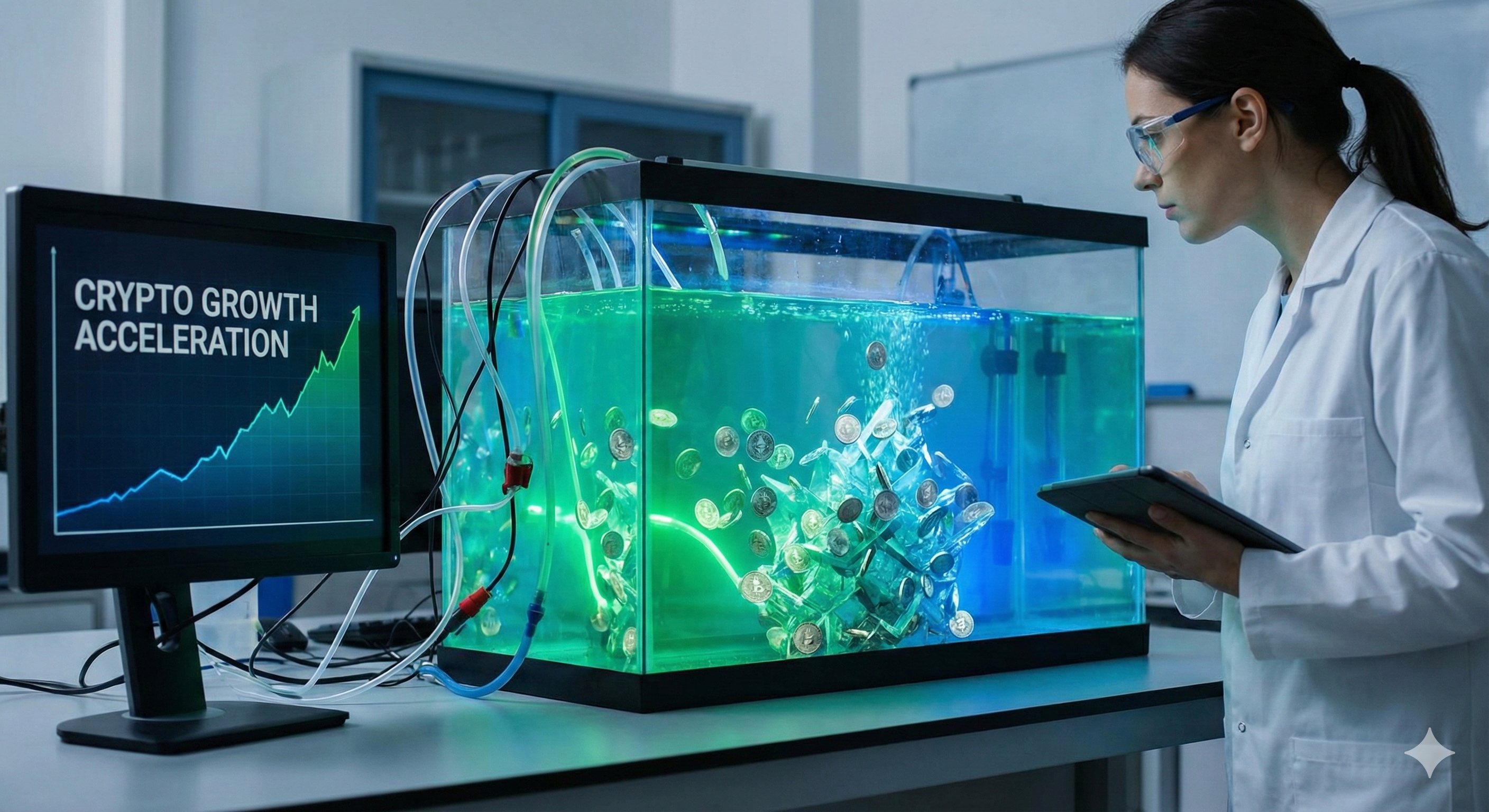
The laboratory was silent, save for the low hum of the Quantum Processing Unit in the corner. Dr. Aris Thorne, a computational sociologist, stood before a massive glass tank. Inside, there was no water, only a suspended holographic void.
His student, Maya, adjusted her glasses. "I thought we were studying economics, Dr. Thorne. This looks like biology."
"It is biology, Maya," Aris replied, tapping the glass. "Economics is just the biology of human behavior. Today, we aren't looking at charts. We are running 'The Velocity Simulation.' We are going to visualize exactly why cryptocurrency grows faster than any financial system in history."
Aris initialized the experiment.
Phase 1: The Traditional Control Group
"First," Aris said, "we simulate the old world. Centralized banking."
He pressed a blue button. In the left corner of the tank, a single large golden sphere appeared. It was heavy and bright.
"This is the Central Bank," Aris explained.
Slowly, tiny droplets of light (money) began to trickle down from the sphere to smaller spheres below it. The flow was steady but slow. It moved through pipes, hit valves (regulations), and stopped at checkpoints (borders).
"Observe," Aris noted. "Friction. Every transaction takes time. It takes 3 days to send money across the tank. The growth is linear. Predictable. Slow."
Phase 2: The Crypto Variable
"Now," Aris said, his eyes gleaming, "we introduce the Decentralized Variable."
He pressed a red button. In the right corner of the tank, he didn't create a large sphere. Instead, he dropped a single, tiny digital spore. It floated in the dark void.
"This represents the Genesis Block," Aris whispered. "Watch."
For a moment, nothing happened. Then, the spore split. One became two. Two became four.
"This is Cellular Mitosis applied to finance," Aris said. "Peer-to-peer."
Phase 3: The Network Effect (Metcalfe’s Law)
Suddenly, the growth changed. It wasn't just copying itself anymore. Thin, glowing filaments began to connect the dots.
"Here is the science of the speed," Aris pointed to a glowing web forming in the air. "In the old system (the blue sphere), if you add a new person, the system just gets one person bigger. But here? When a new node joins, it connects to every other node."
He turned a dial labeled Accessibility.
"In the traditional banking world, you need an ID, a physical address, and a credit score to join. That acts as a filter, slowing growth."
Aris swiped the filter away for the red simulation. "In Crypto, the barrier to entry is zero. Anyone with a smartphone becomes a node."
The reaction in the tank turned violent.
The red spores didn't just trickle; they exploded outward like a star going supernova. Because there were no "pipes" or "checkpoints" to slow the flow, value moved instantly from one side of the tank to the other.
Phase 4: The Feedback Loop (FOMO)
"Now for the final catalyst," Aris warned. "Human psychology. We call this the Positive Feedback Loop."
He injected a simulation of 'Rising Value' into the tank.
As the red web glowed brighter, the simulation programmed the "neutral" particles to be attracted to the light.
The Science: The brighter the network glowed (Price Increase), the more particles rushed toward it (Adoption).
The Reaction: The more particles rushed in, the brighter it glowed.
It was a self-feeding engine. The tank was blinded by a flash of red light. The structure wasn't a pyramid or a ladder; it was a sphere of pure, high-velocity energy.
Maya stepped back, shielded her eyes. "It's unstable! It's moving too fast!"
"It is volatile," Aris admitted, watching the light flicker wildly. "That is the price of speed. Without the friction of the old valves to slow it down, it experiences turbulence. But look at the volume."
Maya squinted. The blue "Traditional" side was still trickling slowly, a neat little fountain. The red "Crypto" side had filled the entire right half of the tank with a complex, neural network of light.
The Conclusion
Aris powered down the simulation. The hologram faded, leaving the room dark again.
"So," Aris asked, "Why does it grow faster?"
Maya looked at the empty tank, the image burned into her retina.
"Because it's organic," she realized. "The old system is a machine with gears that rust. The crypto system is a fungus. It’s a network. It grows from every point simultaneously."
"Precisely," Aris smiled, picking up his tablet. "Traditional money moves at the speed of bureaucracy. Crypto moves at the speed of the internet. And in the world of science, light always travels faster than matter."
The Scientific Breakdown
Why did the experiment work?
Decentralization (The Spores): Growth happens everywhere at once, not just from the top down.
Low Friction (No Pipes): Removing intermediaries (banks) increases the velocity of money.
Metcalfe’s Law: The value of the network increases exponentially (n^2) with every new user, creating a gravitational pull for new adoption.