
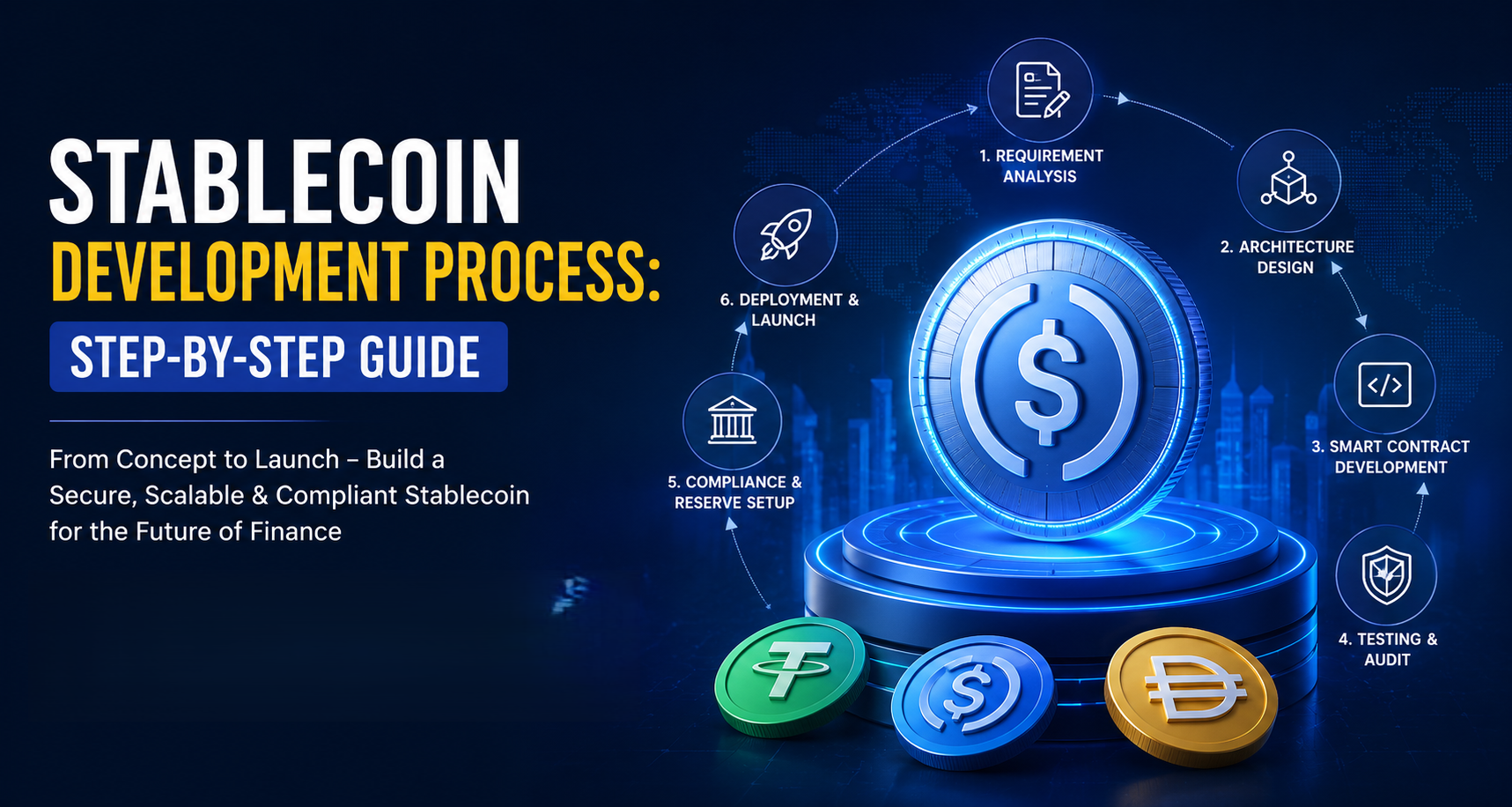
Stablecoins now settle trillions of dollars in value every year, and they've quietly become one of the most important pieces of financial infrastructure in crypto. If you're a founder, fintech team, or developer wondering how a stablecoin actually gets built from the first design decision to a live mainnet launch, this guide walks through the entire process in order.
We'll skip the hype and focus on what actually happens at each stage: the decisions you need to make, the technical work involved, and the regulatory guardrails that now shape every serious stablecoin project.
A stablecoin is a cryptocurrency engineered to hold a steady value, usually pegged to a fiat currency like the US dollar, but sometimes to gold, oil, or even a basket of assets. Unlike Bitcoin or Ethereum, which can swing 10% in a day, a well-designed stablecoin should trade within fractions of a cent from its peg.
That stability is what makes stablecoins useful for actual money-like behaviour: payroll, remittances, merchant payments, and as the base currency inside DeFi protocols. They work because something fiat reserves, crypto collateral, or an algorithm backs the promise that one token equals one dollar (or whatever the peg target is).
Step 4: Choose blockchain and tech stack
- Select your primary chain (Ethereum, Solana, etc.) based on liquidity, speed, and tooling
- Pick your smart contract language (Solidity, Rust) to match the chain
- Plan oracle integration for reliable price feeds
Costs vary widely depending on complexity, but stablecoin development services projects commonly run anywhere from the tens of thousands of dollars for a simple, provider-assisted launch up to several hundred thousand dollars for a fully custom build with independent audits and bespoke compliance infrastructure. Security audits, smart contract development, and third-party integrations tend to be the biggest line items.
For teams that don't want to build everything from scratch, white-label providers like Paxos or Coinbase can handle reserve management and core regulatory compliance, leaving your team free to focus on the user experience, integrations, and the features that actually differentiate your product. A hybrid approach white-label issuance underneath, custom application layer on top is increasingly the default choice for teams that aren't planning to operate at multi-billion-dollar scale.
Building a stablecoin isn't a single technical task it's a sequence of interlocking decisions across economics, engineering, and law, where each stage constrains the ones that follow. The teams that succeed are the ones that treat the regulatory and stress-testing work with the same seriousness as the smart contract code, because a stablecoin's entire value proposition rests on a promise that has to hold up under pressure, not just in a calm market.